Labels
Thank you for visiting Little Schoolhouse in the Suburbs. Please subscribe and you'll get great learning tips and how-to activity articles delivered to your inbox, for free!
Showing posts with label Organization. Show all posts
Thursday, February 23, 2012
How to Homeschool Multiple Ages
My kids are K-3. Three different grades. All pretty much need me to read their material aloud. My baby sleeps...so far. But given at how many subjects there are and yada yada, three grades can get pretty complicated even when the youngest is only in kindergarten. I would say the secret is knowing what you can do together, and knowing what have to do one on one. Unfortunately, I can't give you a recipe for that. It's a personality thing, but I can tell you how I do it.
1. Start your day together.
We begin with a really short prayer "Jesus, bless our school day. Be with us and help us to be with you." Then I read the saint of the day aloud from the Saints for Young Readers book. For you Charlotte Mason lovers, I do have them each tell me something from the beginning, middle, and end of the story (for younger kids) and a fuller narration for the older kid. We go in order of youngest to oldest.
2. Bundle your memory work.
As a classically based school, we have things to recite. BORING. But now, this is my favorite time of day! Kindergartner just has a poem, personal info like address and birthday, and memory songs like Days of the Week. Second Grader has poetry, catechism, phonograms, and states and capitals. Third Grader has all that plus Latin and history dates and skip counting the multiplication tables. But, we do it TOGETHER. That means I don't ever have to "review" old material individually since they just said it with the little kid. And it's easier for the little kids to memorize later because they sat through it a hundred times.
3. Provide busy centers.
Each week, I have a shelf of busy stuff. It's only allowed during school (which makes the activities seem "special".) During Recitation, or anytime they're finished with their work, or are working and need to fidget, what-have-you...all the kids use it. My usually formula is...something to build with, something carpentry-like, something sewing-like, something puzzle-like, something sensory, something grody or cool. In a Montessori classroom, you might be able to leave all this out, but since my kids are older, I rotate frequently. They see something for one week every month or so unless it's a HUGE hit, and then we wear it out and put it away for longer.
4. Organize your individual sessions according to naughtiness.
Personality...I mean personality! After Recitation, we start our individual sessions. Each child has "with me" work and "alone" work. Usually just writing. I make them do their "alone" work while I do Kindergartener's work in my lap. (We're still all in the same room, now.) This is so that once he's done, he can play and has at least one older sibling to play with. Next, I work with Second Grader since if I let her get playing on something, she can't stop easily and throws a fit. Finally, I work with Third Grader, since he's my easy baby. He doesn't care if he's got a good game of Beyblades going. He comes when I call.
5. Limit your curriculum priorities.
We have the FIVE R'S: Recitation, Reading, Writing, Arithmetic, and Religion. That's our core. Everything else is a side event. We recite together, we write together, by-enlarge our religion is together. math and reading are one on one. The last part of the individual work with me is "subject time." This is usually just for the Third Grader. A few times a week we need to read some science, history, or religion lessons. Then we are technically DONE. Well, there is one vestigal requirement for the day happens after dinner; the kids read easy readers aloud to us. M-TH, this is not optional. 15-30 minutes each for second and third grade. If it's too close to bed time, one reads to me and the other to hubby.
Yes, we have literature and natural history and geography reading and whatnot, but they are SECONDARY and I don't stress if we get behind in them. Yes, they're are actually my favorite subjects and the thing that makes me love homeschool and feel like I accomplished something beautiful, but I have to swallow that and identify the priorities.
6. Reserve a day for music, art, and worksheet time.
But where's the music and art and...and...and? It's called FRIDAY. All subjects are M-TH except math. Math is Friday and then all the art, music, worksheets, journaling, drawing lessons or anything else I like. Sprinkling those throughout the week just stresses me out. I can't keep up with what child does which on what day. And for music, we have Music Masters and matching coloring pages and picture books. We rotate through them a few times K-3. We listen to them on Friday and color or narrate, for the older children. Art, we use Mommy, It's a Renoir (according to age) and I give an individual drawing lesson from Draw Squad or the Montessori Inset lessons according to skill level. Any worksheets, like Hayes Music lessons or Abeka geography, or Seasons and Living things are all done on this day.
7. Bundle read-alouds at the end of the day.
At the end of each school day, we come together again for read-alouds. I try to read about 30 minutes. This is where all the literature happens. It's not divided by grade. I just have a master list and I rotate through it. And for you Charlotte Mason lovers, this is where all your stuff happens. I have a second layer of reading on top of the regular literature for living books in geography, natural history, liturgical year, and history stories. But remember, these are not the #1 priority. I got all that done in the morning. This is the fun part.
This is where you find Burgess, Holling C. Holling, and Baldwin. But again, I don't divide it by grade, just responsibility. If you're in kindergarten, you don't narrate and journal. You can play with the busy centers. If you're older, you have to tell it back to me. Any book that you weren't old enough to narrate the first time will likely come back around in third grade.
So here's the priority schedule:
Monday through Thursday
Religion: Prayer and saint story
Recitation
Kindergartener's 3R's, others WRite
Second grader's 2R's, others play
Third Grader's 2R's, others play
DONE (I usually read aloud for at least 30 minutes or dabble in their once-a-week subjects to lighten Friday)
*Evening easy reader practice after dinner (not optional)
Friday
Prayer and saint story
Math, Worksheets, Any once-a-week subjects we didn't do, Art, Narration Illustrations, and Music
DONE (But I might read aloud cause I love it.)
Friday, February 17, 2012
Our Morning Routine
My days are simple, but explaining what I do when and why can be complicated, so I'll break it up.
One way or another, I have to be up at 8AM to get baby up. She needs to go down for her nap at 10AM, so I can do school. But, generally, I am comatose in the morning, slurping coffee and whisper-barking at people hush, "It's MORNING, people!" If I have the presence of mind to go ahead and take my shower when I get out of bed, I tend to be nicer.
By 8:30, we have to get moving. Which means they move and I drink more coffee. Have you said hello to Jesus in your heart this morning? Brushed teeth? How's your room? Any laundry to throw in the washer? Spread up the bed. Alright, everyone hit the tubs, get dressed. Now go back and fix the bathrooms you just killed.
By 9:30 I need to be feeding the troops so we can get the dishes unloaded and reloaded. After that we do some cross-crawling and sing along with School House Rock multiplication. I know that sounds nuts, but my third grader is an auditory learner and sings his multiplication in the morning. And see THIS article about the cross-crawling.
Hopefully, we head upstairs for school at 10AM.
Coffee and delirium
--------------------------8AM-BABY
UP--------------------------
8:30-more
sitting, but barking orders from computer
Morning prayer
Brush teeth
Clean room
Straighten bed
Get showered /dressed
Check laundry
Check bathroom and hall
Check living room and
kitchen
9:30
Eat and chores
Schoolhouse Rock and Brain
Gym
Wednesday, February 1, 2012
Setting Up Centers
For the first fifteen minutes of our school day, I set out all the activities for kids not in the back with me. I lay out the green mats on the floor of the living room and maybe tie some braiding scarves to the leg of the TV stand.
If I have something that works best in the dark, I put that in the coat closet.
But, the big action area is the table. I typically set out four to six activities that can survive getting dripped on with ranch.
Tuesday, January 31, 2012
Our School: Work Trays Instead of Boxes
I think it's most correct to say that "I" use work trays. Or work boxes with trays instead of boxes. Whatever.
Anyway, each child's crate has a set of dollar store cookie sheets and the individual subjects stacked on each. Since the kids do most of their work with me, I find that the stack of trays keeps me organized, not them. I do, however, send them out to do they're "alone" work with a stack of trays.
Trays just take up so much less space! Above you can see that I have six subjects stacked up for my nine-year-old and it barely takes up more space than the one subject I have set out for my second grader.
Below is the oldest, doing his reading. His tray has a book, chart, and timer.
Here's another shot of the trays spread out. This is memorization (Latin, history dates), cursive, and spelling with a flip camera to make it more entertaining. I don't force a certain order, in fact, I just stack the trays according to ease of transport. That one with the camera would be on top since the stack would tip unattractively.
More trays all spread out. Big kid loves to take pictures.
Thursday, January 12, 2012
Mama's Box of Magic Cards
Since I don't have a dedicated school room, I keep this magic box of cards to fuel my one-on-one time with the younger kids, and once in a while, the Bigs.
My very favorite is the science sequencing cards. In our school, sequencing is the BIG DEAL in kindergarten. First this happened, then THIS happened, and FINALLY this happened. I HEART using science for kindergarten sequencing. No lame-o sequencing of teethbrushing. I want to slip in some RICHNESS.
I won't give you ever single specific link, but if you are willing to file through the freebies at each site, I can tell you where to get them:
1. FREE Cicada Life Cycle at Montessori Tidbits
2. FREE Butterfly Life-cycle from Montessori Mom
3. FREE Frog life-cycle from Montessori Mom
4. FREE Moon cycle from Montessori Mom
5. FREE Season cycle from Montessori for Everyone
6. FREE Apple life-cycle from Montessori for Everyone
7. FREE Pumpkin life-cycle from
Montessori for Everyone followed by a baby dino life cycle from ???.
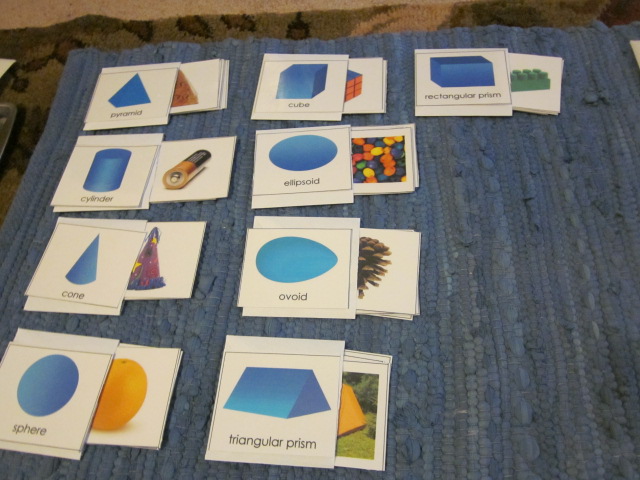
I also like sorting and go-together cards the are science-based.
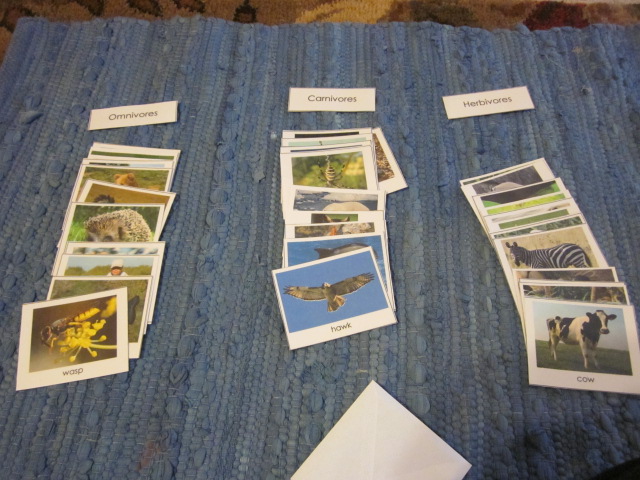
1. (not free) Carnivore, Omnivore, Herbivore cards from Montessori for Everyone
5. FREE butterfly sorting and go-togethers from the classified cards at Beautiful Sun Montessori. Not all of the butterflies have a pupa and larva to match, but ENOUGH do to make it worth your while.
My daughter LOVES them!
Tuesday, January 10, 2012
Our Schoolroom
I have one lone shelf for my Montessori set-up. The only items that you will find there are set out daily, and as usual, the story-telling bag is already gone and in use.
- Our local vertebrate classified cards
- Zach's known sandpaper letters
- A base ten bead set ('limited bead material' to Montessorians)
- Zach's object boxes for sorting by sound (matches the sandpaper letters)
- Callie's object boxes for word building ('moveable alphabet' to Montessorians)
- Our storytelling bag (read: 13 peg people plus all the leftovers that didn't make the object boxes)
This is the only section of our homeschool with more than a one-week life span. The rest of the house looks like this:
Trays on the tables, floor, and fireplace. Changed weekly.
Sunday, November 6, 2011
Our School: No Dedicated School Room
We have a LITTLE house. We homeschool down the street in my MIL's LITTLE house. Why the hike? Well, the chores in her house don't call to me while I'm trying to concentrate on the kids. When I'm there, I just do school. AND I ALWAYS CLEAN UP. At my house, there's no deadline for things to be tidied up...so it won't happen until it's DREADFUL. At her house, it all has to be put away by 3PM when she gets home, unless I wanna be Rudey McRude.
This means is that there is no dedicated school area, which is no big deal for using the curriculum as assigned. That's mostly books and papers. A crate for each kid is sufficient.
But for all the centers I set up? Everything has to be set out and put away each day. That seems like a lot of work, but it's not that bad. Well, Monday is tough, but once the trays are set up, I just tuck them into a crate at the end of the day. Set up and and take down are a few minutes each.
DISCLOSURE: I'm a PREP WORK gal, but not a supervision or clean-up gal. I want to do all of my work ahead of time so life is really easy during and after school time. This makes me lean towards a certain flavor of activities for my kids. I don't want activities that generate a lot of end products. So, if you look at this and say "GOSH, that's a lot of work, I'd rather just give them a bowl of cornstarch goop and food coloring, " realize that we're pretty much doing the same amount of work, just I have no clean-up or in-the-moment supervision. It's all about WHEN you like to work. If your Effort Happy Place is supervision and clean-up, my methods may not be for you.
So how do I manage all these centers?
1. I limit the number of activities I set out each week. Somewhere around ten for the free choice activities. In a traditional Montessori environment, there is a lot more choice and variety, but ten seems sufficient for us. By the end of the week, they've tried it all, even the stuff that looked boring. I only change an activity if I guessed wrongly.
For example, Zach used to be really interested in fingernail clips. I didn't realize that he'd mastered them. So when I set out a cool clipping activity, it got NO action. "That's for little kids, Mama." So I changed it the next day.
2. I choose activities that don't have beloved end products that must be cherished and stored. Well, most don't. The melty beads have one small end product. The punch pins and stamping don't seem to generate anything people want to hang up. But, I would NEVER set out a huge pile of paper and colored pencils. What a mess! If I need an art station, I give them a their own sketch book so that there aren't papers everywhere. Any cutting activities are set up in such a way that the clippings are contained.
3. I use uniform containers. Dollar store cookies sheets lined with foam or construction paper fit perfectly into Walmart crates. Dollar store rectangular trays stack well on top. For water activities, I use over-sized dollar store muddy boot trays which I store on top or beside the crate stack.
4. I try to keep them "mat-trained." At the table, they rotate between the centers. For floor activities, they each have a mat. It's their area that no one is allowed to bother. If an activity is on their mat, it's theirs until they are done. That mat is where THEY make the rules. They decide if others are allowed to enter and play. They decide what activities come and go. But, when they want to switch activities, if they want their new activity to have the same protection, they have to keep it on the mat, which usually means that other activity has to be put back. Very rarely can they fit two trays on one mat. And the excitement of being the ruler of their own square of the universe is enough motivation to get them to put things away. But, it's important to keep that square of the universe small, or the auto-clean up won't happen.
5. I set out activities in the same spots each week. Activities that can have food and drink near them are on place mats on the table. Activities that will be ruined if spilled upon, are on the fireplace. Activities that have real mess potential or are really physical are outside.
Subscribe to:
Posts (Atom)