Thank you for visiting Little Schoolhouse in the Suburbs. Please subscribe and you'll get great learning tips and how-to activity articles delivered to your inbox, for free!

Showing posts with label Manipulatives. Show all posts

Friday, February 3, 2012

Carrying: Abacus...Hallelujah!


The first time my daughter and I made it through her math without fighting....

For a creative, math resistant, art-loving kid, I highly recommend a bead frame.  This one was $5 at Tuesday Morning.  To use it on normal math, you first need to do a lot of practice with her on simple addition so she can get used to "exchanging."

Example:  Put 8 on the frame, then add 4 more.  1, 2, exchange, 3, 4.  you should have one blue bead and six yellow.  

Do that until she can start bringing you the answer in another room.  "Go add 15 plus 7 and come back."

We use it for counting money, adding with carrying, skip counting, etc.

GLORIOUS.

Thursday, January 26, 2012

Literacy: Picture Books For Fluency


There is a big push to get kids out of picture books and into chapter books.  As a picture book writer, I can tell you that's silliness.  Picture books are not just for babies!  Since they are designed to be read BY AN ADULT, the language can be quite challenging.  Plenty challenging to assign to your third or fourth grader.  Unless your child abhors them, I find picture books to be a great way to build fluency.  Since my third grader reads only 20 minutes a day in school, a chapter book would take him FOREVER, whereas a picture book "rewards the reader" in much smaller increments.

So, here's a list I've worked up of great classic picture books ordered by AR level, so you can judge their reading level.


Wednesday, January 25, 2012

Monday, January 23, 2012

Motor Development: Table Lessons


Little Kid got bored doing his school work, so we took a break for some practical life lessons.

First, we went over the names of something nearby. 
Cord, plug, socket (or outlet), floor lamp, bulb, lampshade (none of my kids knew "lampshade."  Huh.), table, table legs, table leaf (WHAT?).  He didn't understand "table leaf" so...we learned how to table apart.   

  And put it back together. 


 And take it apart. And put it back together.  You know how it goes. 

After all that work, his muscles were all tuckered out.  So, we had a lazy susan lesson.  He'd been curious about this little gadget for ages.  We set up a tiny dish part and practiced using the lazy susan and our good manners.


Then, of course, since I'm an old waitress, I showed him how to "bus" the table.  Then he did it.....about ten times.  HA!


Thursday, January 19, 2012

Teaching 1, 10, 100, 1000 with beads


Of all the materials I've tried from the land of Montessori, this particular bead material is my favorite.  I got it for $15 from Alison's Montessori.  It contains nine unit beads, nine ten bars, nine hundred squares, and one thousand cube.  They are connect nylon beads, not near the same quality as the individual bead sets, but they are sufficient for me.  They are far superior to the base ten sets at Amazon due to the weight of the material.  A typical thousand block in conventional base ten material is hollow and doesn't FEEL like 1000.

My favorite Montessori album is the one at http://www.montessoriworld.org/.  I love the simplicity of the outline.  Montessori has such interesting ideas that it's a tempting to proliferate material in her style and clutter up the curriculum.  Montessori World does not make this mistake.

Decimal quantities is taught directly after the numerals and quantities of 1-9 are mastered.

Exercise 1:  Introduce the quantities 1, 10, 100, 1000.  Encourage the child to feel the quantities and say their names, hand them to you or move them around the mat when the names are said, and finally identify them when presented alone.  What is this?  Hundred.


Exercise 2:  Once the quantities are mastered (without numerals), demonstrate going to the next hierarchy every time one passes nine. Ten units is actually one ten bar.  Ten ten bars are one hundred, and following until we get to the thousand block.  The is repeated on subsequent days until the child has mastered it.


Exercise 3:  Naming Quantities:  I call this "fetching."  Hand me two hundreds.  Good, put them back.  Now go find eight tens.  

Numerals are not introduced until these three lessons are mastered.

Friday, January 13, 2012

Bible Story Props


In kindergarten, we work on sequencing.  

Here's my son's story of Noah:  

"Noah got out of a big boat, hit his head on a rock, and died."  

I don't remember that part, you?  

Anyway, he's very tactile so I thought it would help him to play with the characters as he listened to the story.  There are some really expensive sets out there, but here's mine:

Materials:  a few packs of peg people from Michaels, all the doubles and leftovers from making the object boxes, a leftover large makeup bag for storage (not shown), a dollar store tray, some construction paper, and a slab of whiteboard from Depot.  Ignore that last item, it's not necessary.  It was just handy.  

To use:  

1.  Pre-read your story enough to know if it's in the desert or water or whatever to choose appropriate construction paper floor setting.  
2.  Dump all your junk into a lined tray.  
3.  Assign and dress characters (Our King Saul today wore a tea cup for a crown and David had a sauce pan full of mini fruit and wooden baseballs for rocks.  Goliath wore a large rice bowl for a helmet and had a wooden bat and disk propped on him for a shield and sword. I LOVED it.)
4.  Read story.  
5.  Have children retell it using the characters.
6.  Wonder how dinosaurs and a polar bear snuck into the back of the Philistine army and if that may have turned the tide....

Thursday, January 12, 2012

Mama's Box of Magic Cards


Since I don't have a dedicated school room, I keep this magic box of cards to fuel my one-on-one time with the younger kids, and once in a while, the Bigs.

My very favorite is the science sequencing cards. In our school, sequencing is the BIG DEAL in kindergarten.  First this happened, then THIS happened, and FINALLY this happened.  I HEART using science for kindergarten sequencing.  No lame-o sequencing of teethbrushing.  I want to slip in some RICHNESS.  

I won't give you ever single specific link, but if you are willing to file through the freebies at each site, I can tell you where to get them: 

1.  FREE Cicada Life Cycle at Montessori Tidbits 

2.  FREE Butterfly Life-cycle from Montessori Mom

3. FREE Frog life-cycle from Montessori Mom

4.  FREE Moon cycle from Montessori Mom

5.  FREE Season cycle from Montessori for Everyone

6.  FREE Apple life-cycle from Montessori for Everyone

7. FREE  Pumpkin life-cycle from  Montessori for Everyone  followed by a baby dino life cycle from ???.

I also like sorting and go-together cards the are science-based.

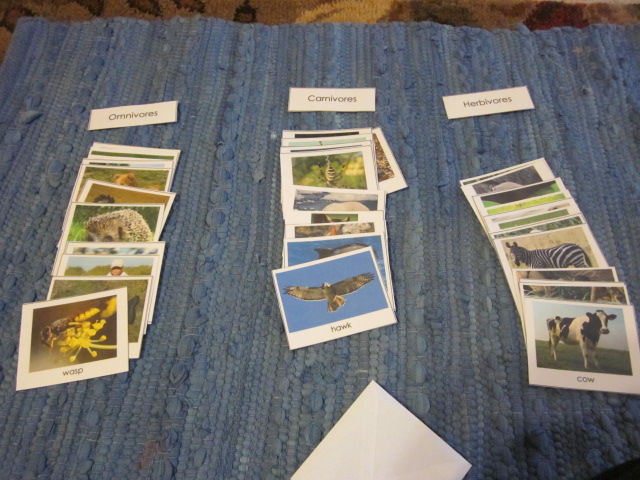
1.  (not free) Carnivore, Omnivore, Herbivore cards from Montessori for Everyone

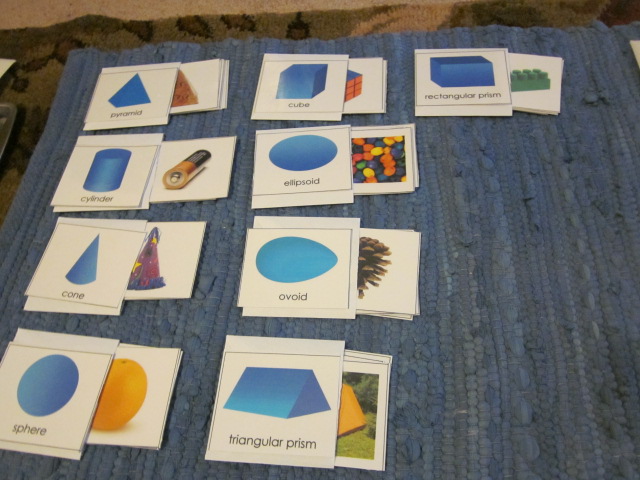
2.  (not free) Real life Geometric object sorting cards from Montessori for Everyone


3.  (not free) Patterns in Nature sorting cards from Montessori for Everyone


4.  FREE sorting and go-together cards from Montessori for Everyone and the left from a garage sale.


5.  FREE butterfly sorting and go-togethers from the classified cards at Beautiful Sun Montessori.  Not all of the butterflies have a pupa and larva to match, but ENOUGH do to make it worth your while.

My daughter LOVES them!

Wednesday, January 11, 2012

Alphabet Object Boxes


The boy uses these to sort beginning sounds.  He pulls the object out of the box and places it below the glued letter inside the lid.

Materials Needed:  Dollar Tree foam letters, Walmart $.94 pencil case, glue, paint pens, and a crapload of objects from Dollar tree, Michaels, Hobby Lobby and the like.  I tried to do six per sound.  Our book (100 Easy Lessons) does the phonics in this order 

1.  The "mesa" box.  I say it MAY-suh, but it should be MEE-suh.  Anyhoodle, it's M, long E, S, and short A.


M: milk, monster, moose, makeup, monkey (ignore alligator, he belongs in the last row--quality control stinks here)
long E:  equals, easel, evil, eagle, earrings
S:  star, stapler, scissors, spoon, sea horse, school house, snake, sewing machine
A:  ambulance, antelope, ant, astronaut, apple

2.  The "dirt" box:


D: disk, dish, daisy, dragonfly, dressform (something is missing.....hmmm.  Oh, it's a dinosaur.)
short I:  insect, infant, inchworm, igloo, iguana
R:  rock, rhino, ray, record, rice, ring
T:  turtle, takeout, tree, tiger, tractor, and a missing teapot (currently serving a fore mentioned dinosaur)

*The kids don't usually use these for what they are intended, but retrieving them from the correct box and returning them to said box is kind of like sorting, right?

3.  The "CONTH", which is now the CON box since I can't find a darn thing in the word that uses the second sound of TH.  This, that, them...not very object friendly.


C:  cow, cactus, cat, crown, cookie, camel
short O:  olive, ostrich, octopus (still working on this pile)
N:  needle, necklace, nail, nickel, nuts, nail polish


Monday, January 9, 2012

Place Value: Base Ten Blocks


This is the FIRST time my daughter understood what ones, tens, hundreds meant!

To play this game, you need two boards (laminated paper) labelled as you see in the picture, preferably NOT the same color as your blocks.  You also need base ten blocks and three dice.

It's usually played as "Race to 100", but I found that we didn't get enough practice making change for that to help.  We race to three hundred, hence the third die.  With one die, we'd be there all day.

The first player rolls the dice, calculates how many one blocks to pick up, and then makes any necessary exchanges if he has too many blocks in a column.  Play continues until someone reaches 200.  We played this every day for a week.   She still couldn't "carry" on paper, but at least she got the place value idea.  And kicked my tail at this game, lots.

Variation:  When we started learning borrowing, we played this game BACKWARDS.  Start with three hundred and race to zero.


Saturday, December 17, 2011

Literacy: How to Build Object Boxes


I use object boxes A LOT.  I totally stole it from Montessori schools, so don't think I invented this at all.  However, building object boxes can be EXPENSIVE.  Lemme tell ya about how I did it on the cheap and then I'll tell you about what's in the boxes.

Finding cheap objects:

1.  Michaels Craft Stores:  The majority of my objects came from there.  You want four different things:

  • the mini flat wood doodads for gluing on something else wood, usually a display of a hundred tiny drawers.(bus, sun, pig shown above)
  • Crazerasers at $1 each 4-pack assortment (bag, bin, pin, and hat shown above)
  • The kids necklace section (dog, cat, shown above)
  • The 3-d wooden doodad section (egg, pot, bat shown above)
2.  Dollar store:  Only the rat above came from there, but I also got squirty sea creatures for the ray and whale and others, and the bug pack, and some snake and rats.

3.  Hobby Lobby:  Dollhouse miniatures that work out to less than $.50 per usable object. (see mop and lid above)  The tool pack, mops and brooms, pots and pans, food pack, dishes and silverware and a couple of others were the only ones on budget.  

4.  Junk drawers:  screws, bit (shown above), clips, etc were found in piles of nonsense around my home.

TYPES of object boxes:

Materials needed:  objects, lots of plastic bags, sharpie, set of dollar store foam letter puzzles in lower case.

1. Sort objects by beginning sound.  

2.  Separate out those that are multi phonogram, harder to spell words and use them for your initial sound sorting.  Ex:  "Whale" has two things going on.  WH and the silent E.  This makes it really too advanced for teaching the wh or the silent e or using for spelling purposes.  But since initial sound boxes are NEVER spelled, a little kid can sort that into a W column for the beginning sound, so my whale went in the W bag.

3.  Toss in a foam letter for sorting purposes.

4.  Next sort out all objects that are three and four letter phonetic words (pig, cat, dog) and put those into a bag for elementary word building once all the letter sounds are learned.

5.  Next sort out all objects that have a single multi-letter phonogram or demonstrate a single spelling rule according to your phonics scheme.  Since this gets pretty complicated trying to find single phonogram words, I will sometimes use objects that have two phonograms but one was already learned a while back.  Ex:  "juice" demonstrates the ui phonogram AND the c,g,job 3 silent e rule.  Since I taught the silent e rule after the "ui" sound, it went in the silent e bag.  Below you can see that I had already taught oy, oi, and er before this lesson, so I didn't mind having those phonograms in my c,g, job 3 bag.


6.  Finally, fill in your bags with leftover doubles and random crap from around your house.  I try to get at least three object per Kindergarten initial letter sound and at least one per multi-letter phonogram (hopefully more).

7.  Put all the odd objects that aren't going to fit your scheme into church busy bags or something.  Crazerasers are a big hit around here.

Literacy: Phonogram Rocks


Materials Needed:  Dollar Tree river rocks, Dollar Tree knick-knack trays and/or empty Dollar Tree Zen Gardens, two paint pens(red for consonants, blue for vowels), matte clear coat spray

How to Make

1. Sort rocks according to size and how many you can fit in your storage system.  You want at least three rocks for vowels and two for each consonant.  I only do one rock for multi-letter phonograms.

2.  Draw on rocks and allow to dry completely.

3.  Spray with hubby's acrylic coat spray stuff.


I use these for teaching introducing new phonograms.  I don't use them for mass word building.  There just aren't enough rocks.  I use a printed alphabet for that.


In addition to the phonograms themselves, I also made a few rocks for symbols.  Our program has you underline long vowels and put numbers below your silent "e".  See an example below.


But the thing that I use them MOST for is our daily phonogram dictation.  Below, she is quizzing herself on the sounds, and only those she knows are invited to the "party" at the top of the mat.  The first picture in this post is another way we quiz.  I say, "Put all the "er" sounds in the box."  Or I say, "Put ch, k, sh away."


I could just have her write or do phonograms orally, but I find that the rocks provide a fuller sensory experience and make everything stick better.


Literacy: Movable Alphabet for Word Building


In Montessori language learning, there is a stage between sound learning and reading.  It's a word analysis exercise that allows the child to build the word without having to read the word.  They can hear the sounds and pull those phonograms from the box, but aren't required to deduce the word from a visual list of sounds.  

This is MAGIC for my daughter.  She is NOT interested in reading.  She is only interested in writing her own story.  I give her objects and she builds the words and arranges them as she sees fit.  

The words shown in this post are too easy for her, but she deigned to build them so I could take a picture.  


Later in the week, after the initial phonogram lesson with the rocks, we use objects or pictures and practice building those words that use the phonograms or spelling rules we're learning.  


If you want to make your own set, and you use Spalding like me, I recommend printing out this set rather than making your own like I did.  I first printed out this set because I'm a sucker for their colors and font, but Montessori doesn't do the phonograms the same way that we do in our program, so every week I have to cut and paste and build rather janky looking sheets (which you can find in my individual phonograpm lesson posts.)  Whatever you do, print out at least 6 of every letter/phonogram and ten of the vowels and common letters.  (I never have enough L's.)